

Credit & article source:
Daniel Hartweg
Organizations invest substantial resources in professional development, yet research indicates that knowledge acquisition rarely translates into sustained behavioral change. Studies in organizational psychology consistently demonstrate that approximately 70% of change initiatives fail, with implementation gaps representing the primary obstacle. The challenge lies not in understanding what professionals should do, but in engineering environments and systems that make desired behaviors inevitable.
The behavioral science framework developed through extensive research into habit formation offers a systematic approach to closing this implementation gap. Rather than relying on willpower or motivation—resources that research demonstrates are finite and unreliable—this methodology focuses on environmental design and behavioral architecture.
The Compounding Effect: Understanding Marginal Gains in Professional Performance
Business leaders frequently overestimate short-term capabilities while underestimating long-term potential. This temporal miscalibration creates a persistent pattern: ambitious quarterly objectives coupled with insufficient attention to the systematic processes that generate sustained improvement.
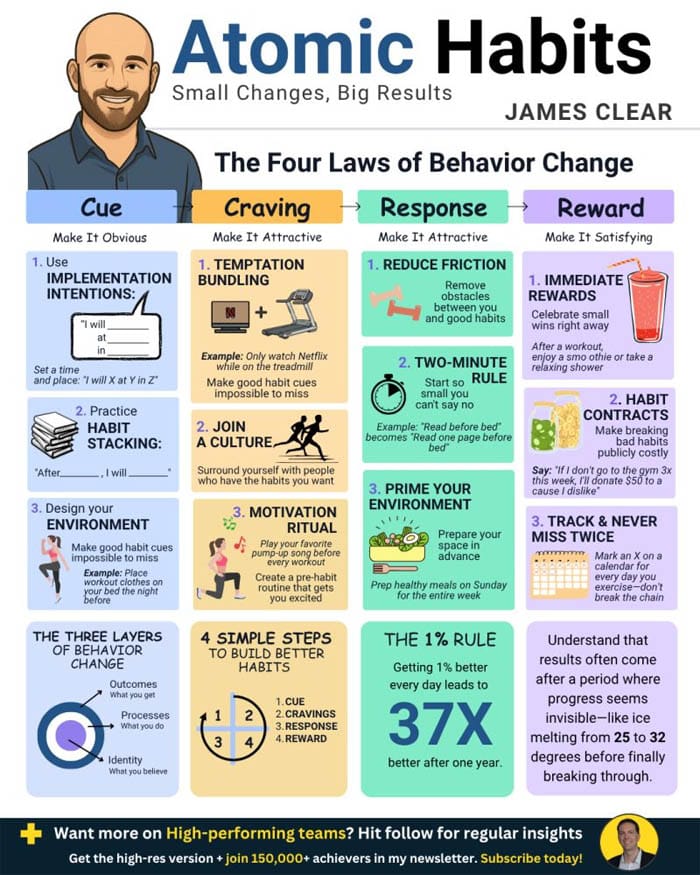
The mathematics of marginal gains illustrates this principle with precision. Professional performance that improves by one percent daily compounds to 37 times the original baseline over twelve months. Conversely, performance that degrades by one percent daily diminishes to near zero. This exponential relationship between small, consistent actions and long-term outcomes represents a fundamental principle in both organizational development and individual professional growth.
Research examining high-performing teams across industries reveals a consistent pattern: excellence results from superior systems rather than exceptional motivation. Organizations that implement effective behavioral architecture consistently outperform those that rely on inspiration or willpower-based approaches.
The Four-Law Framework: A Systematic Approach to Behavior Change
Professional development research has identified four critical variables that determine whether new behaviors become sustainable habits. These laws represent environmental and psychological levers that, when properly engineered, make desired behaviors significantly more likely to occur.
Law One: Implementation Intentions and Environmental Design
The first principle addresses behavioral initiation through specificity and environmental cues. Research in implementation science demonstrates that individuals who establish precise behavioral specifications—defining exact times, locations, and triggering conditions—achieve substantially higher adherence rates than those who rely on general intentions.
Effective professionals leverage three specific mechanisms. First, they establish implementation intentions using the format: “I will [behavior] at [time] in [location].” This specificity eliminates decision fatigue and creates clear triggers. Second, they employ habit stacking, linking new behaviors to existing routines through conditional statements: “After [current habit], I will [new habit].” This technique capitalizes on established neural pathways. Third, they redesign environments to make behavioral cues obvious, positioning tools, materials, and reminders to minimize friction between intention and action.
Organizations can apply this principle systematically by examining workflow processes and identifying opportunities to embed desired behaviors into existing operational rhythms. When professional development objectives are integrated into standard operating procedures rather than positioned as additional tasks, adoption rates increase substantially.
Law Two: Temptation Bundling and Social Reinforcement
The second principle recognizes that sustained behavior requires making actions attractive. Research in behavioral economics demonstrates that individuals are more likely to maintain behaviors when they can link necessary activities with inherently pleasurable experiences.
Temptation bundling represents one effective mechanism: restricting enjoyable activities to occur exclusively during the performance of target behaviors. For example, consuming preferred media content only during professional development activities or exercise sessions. This approach transforms previously challenging behaviors into anticipated experiences.
Cultural engineering represents another critical application. Professional behavior research consistently shows that individuals adopt the habits and standards of their reference groups. Organizations that strategically cultivate peer networks around desired behaviors—creating communities of practice, establishing mentorship relationships, and facilitating knowledge-sharing forums—observe accelerated adoption of professional competencies.
Motivation ritual development provides a third mechanism. Creating pre-behavior routines that generate positive associations—specific music, environmental adjustments, or preparatory activities—can transform psychological resistance into anticipation.
Law Three: Friction Reduction and the Two-Minute Rule
The third principle addresses ease of execution. Research demonstrates that behavioral consistency correlates inversely with implementation friction. Each obstacle between intention and action—whether physical, cognitive, or temporal—reduces execution probability.
Effective friction reduction requires systematic analysis of behavioral pathways. Professionals who optimize their environments by preparing materials in advance, eliminating unnecessary steps, and positioning resources for immediate accessibility achieve substantially higher consistency rates. Meal preparation on Sundays eliminates daily decision-making. Laying out professional development materials the previous evening removes morning barriers.
The Two-Minute Rule provides a specific implementation protocol: reduce new behaviors to versions that require two minutes or less to complete. This approach addresses the psychological resistance to initiating challenging activities. Reading one page, writing one sentence, or conducting two minutes of skill practice creates momentum that frequently extends beyond the minimum commitment. Research indicates that initiation represents the primary obstacle; once behaviors commence, continuation becomes significantly more probable.
Organizations can apply this principle by examining onboarding processes, training implementations, and new system adoptions. Reducing initial complexity and creating simplified entry points dramatically improves adoption rates.
Law Four: Immediate Reinforcement and Tracking Systems
The fourth principle addresses the satisfaction component of habit formation. Behavioral psychology research demonstrates that immediate consequences influence behavior more powerfully than delayed outcomes. Since many professional development activities generate benefits over extended timeframes, creating immediate reinforcement mechanisms becomes critical.
Visual tracking systems provide one effective approach. Research examining habit formation demonstrates that marking completion—whether on calendars, spreadsheets, or specialized applications—creates psychological satisfaction that reinforces repetition. The visual evidence of consistency provides both immediate gratification and loss aversion motivation as streaks develop.
Habit contracts and public commitment mechanisms leverage social accountability. When professionals make behavioral commitments visible to colleagues or mentors, adherence rates increase substantially. The social consequences of inconsistency create additional motivation beyond personal objectives.
The “never miss twice” protocol provides a specific failure recovery framework. Research indicates that single behavioral lapses do not significantly impact long-term outcomes, but consecutive misses initiate regression toward previous patterns. Establishing this as an explicit standard—one miss is acceptable, two consecutive misses require immediate intervention—provides a clear decision rule during inevitable disruptions.
Identity-Based Habit Formation: Shifting From Goals to Systems
Traditional goal-setting approaches focus on outcomes: achieving specific results, reaching particular milestones, or attaining designated accomplishments. Research in behavioral psychology suggests an alternative framework proves more effective for sustained change: identity-based habit formation.
This approach shifts focus from “what I want to achieve” to “who I want to become.” Rather than stating objectives in terms of desired outcomes (“I want to improve my communication skills”), professionals frame intentions in terms of identity (“I am an effective communicator”). This seemingly subtle linguistic shift creates profound psychological effects.
Identity statements activate different cognitive processes than goal statements. When individuals adopt an identity, subsequent behaviors serve as evidence that confirms or contradicts that self-concept. Each action becomes a vote for the type of person they are becoming. Small wins accumulate as identity evidence, creating positive feedback loops that reinforce continued behavior.
Organizations can facilitate this shift by helping professionals articulate the competencies and characteristics associated with excellence in their roles, then supporting the development of habits that align with those identities rather than merely pursuing performance metrics.
Systematic Habit Development Protocol
Effective professional development requires a structured implementation approach. Research suggests the following protocol maximizes success probability:
First, select a single behavioral target. Attempting simultaneous multiple habit formation significantly reduces success rates. Focus enables adequate attention to environmental design and execution refinement.
Second, reduce the behavior to a version so minimal that resistance becomes impossible. This scaling addresses the psychological barrier of initiation while establishing the foundation for subsequent expansion.
Third, apply all four laws systematically: establish specific implementation intentions, integrate social and motivational elements, eliminate friction, and create immediate tracking and reinforcement.
Fourth, implement the behavior daily for a minimum period—research suggests 66 days represents the median timeframe for habit automation, though this varies substantially based on behavioral complexity.
Fifth, once the behavior achieves automaticity, gradually increase scope or add additional behavioral targets.
Assessment Frameworks and Success Indicators
Professional development initiatives require systematic assessment to ensure effectiveness and identify opportunities for refinement. Habit formation success can be evaluated through multiple metrics:
Consistency rates represent the primary indicator—the percentage of scheduled executions actually completed over defined periods. Research suggests that 90% consistency over 90 days indicates strong habit establishment.
Behavioral expansion demonstrates habit strength—whether individuals naturally extend minimal commitments beyond the initial threshold without requiring explicit decisions.
Identity alignment assessment evaluates whether individuals spontaneously describe themselves using terms associated with the target behavior, indicating deeper psychological integration.
Organizations should implement regular evaluation cycles that examine both individual habit formation progress and systematic factors that facilitate or impede behavioral change across teams.
Systematic Approaches to Sustainable Professional Development
The challenge facing modern organizations is not identifying valuable professional competencies but implementing systems that translate knowledge into consistent action. The four-law framework provides a research-based methodology for engineering environments and processes that make desired behaviors inevitable.
By focusing on environmental design rather than motivation, specificity rather than general intentions, friction reduction rather than willpower, and immediate reinforcement rather than delayed outcomes, professionals can construct behavioral architecture that supports sustained improvement.
The compounding mathematics of marginal gains demonstrates that small, consistent improvements generate transformational results over extended periods. Organizations that implement systematic approaches to habit formation—supporting professionals in developing one percent daily improvements—create competitive advantages that compound over time.
The framework’s effectiveness stems from its alignment with human psychology and behavioral science rather than requiring exceptional motivation or willpower. When properly implemented, desired behaviors become the path of least resistance rather than requiring constant effort to maintain.
Professional excellence results from superior systems consistently executed rather than occasional exceptional performances. Organizations that invest in developing robust behavioral architecture create foundations for sustained competitive advantage and continuous professional development.