

Credit & article source:
Sean McPheat
Here’s something that might surprise you: your technical expertise accounts for only 15% of your career success. The remaining 85% comes down to something far more fundamental—your ability to connect, communicate, and collaborate with others.
This insight comes from comprehensive research conducted by Harvard University, the Carnegie Foundation, and Stanford Research Center. Their conclusion challenges everything we’ve been taught about professional development: soft skills aren’t just nice-to-have additions to your resume—they’re the primary drivers of long-term career advancement.
The challenge is that most people assume developing these skills requires extensive training programs or expensive coaching. The reality is much simpler. Small, consistent actions compound into remarkable improvements in how others perceive and work with you.
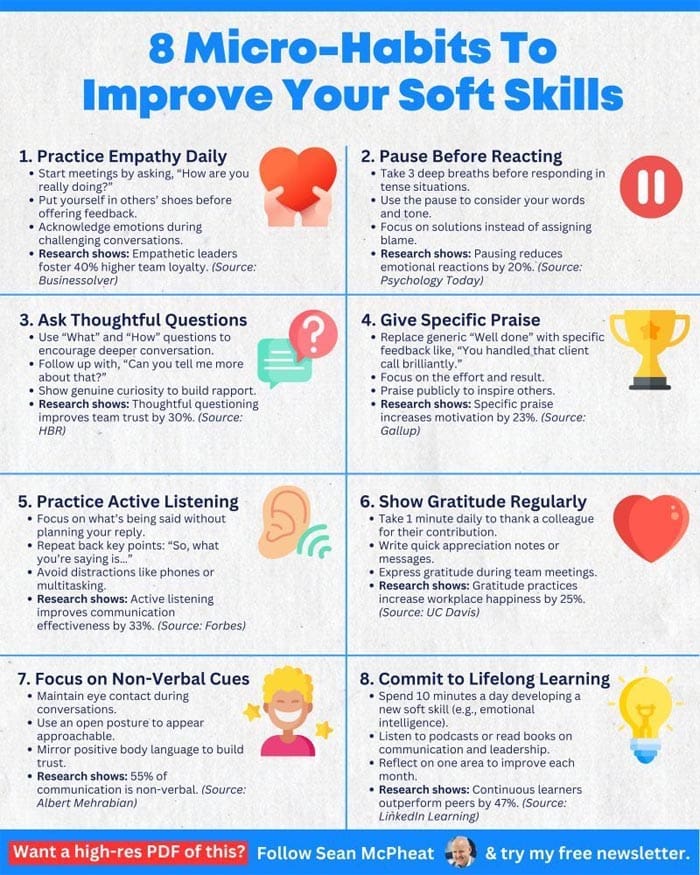
Here are eight micro-practices that can fundamentally shift your professional relationships:
1. Lead with Genuine Curiosity About Others
Instead of defaulting to surface-level pleasantries, try asking, “What’s been the most interesting part of your week?” or “What’s challenging you right now?” This simple shift from perfunctory to personal creates space for authentic connection. Research shows that leaders who demonstrate genuine interest in their colleagues see 40% higher team engagement levels.
2. Create Space Between Trigger and Response
When faced with challenging conversations or unexpected setbacks, build in a brief pause. Take three conscious breaths before responding. This micro-moment allows you to respond from intention rather than reaction, reducing workplace conflicts by approximately 20% and dramatically improving the quality of your professional interactions.
3. Master the Art of Inquiry
Transform conversations by replacing closed questions with open-ended exploration. Instead of “Did that work?” try “What surprised you about that process?” Follow up with phrases like “Help me understand…” or “What else should I know about this?” This approach builds trust 30% faster than traditional questioning methods.
4. Make Recognition Meaningful
Generic praise falls flat. When acknowledging someone’s work, get specific about both the action and its impact. Replace “Nice presentation” with “The way you broke down those complex metrics into clear visuals helped everyone understand the trends immediately.” Targeted recognition increases motivation by 23% compared to general compliments.
5. Become Fully Present in Conversations
Active listening goes beyond hearing words—it means reflecting understanding back to the speaker. Try phrases like “What I’m hearing is…” or “It sounds like the main concern is…” Put away distractions and maintain eye contact. This level of engagement improves workplace effectiveness by 33%.
6. Build a Practice of Appreciation
Gratitude isn’t just good manners—it’s a strategic relationship tool. Write brief thank-you notes for specific contributions. Acknowledge both major wins and small efforts that often go unnoticed. Workplaces with regular appreciation practices report 25% higher satisfaction scores.
7. Align Your Physical Presence with Your Message
Your body language speaks before you do. Maintain open posture, ensure your facial expressions match your words, and use gestures that invite rather than barrier conversation. Since 55% of communication happens non-verbally, this awareness can dramatically shift how your messages are received.
8. Cultivate Continuous Growth
Dedicate just ten minutes daily to learning something new—whether through podcasts during your commute, industry articles over lunch, or brief educational videos. This commitment to growth not only expands your capabilities but signals to others that you’re invested in improvement. Continuous learners consistently outperform their peers by 47%.
The Compound Effect of Small Changes
These practices work because they’re sustainable and immediately actionable. You don’t need to overhaul your entire approach to relationships—you need to be more intentional about the small moments that happen dozens of times each day.
The goal isn’t perfection. It’s consistency. Each micro-habit becomes a building block in how others experience working with you. Over time, these small shifts create a reputation for being someone who truly understands what it means to collaborate effectively.
Which of these practices feels most relevant to your current professional challenges? Start there, and let consistency do the rest.