


High employee engagement leads to 22% more profit. This finding is backed by multiple studies.
Engaged teams have:
- Less burnout
- Higher morale
- Lower turnover
- Better creativity
- More productivity
- Fewer missed days
All of which means…
- Happier teams
- Happier customers
- Happier shareholders
Benefits of Engagement for the company:
- Increased productivity and efficiency.
- Higher customer satisfaction.
- Lower turnover rates.
- Better team collaboration.
- Enhanced company reputation.
- Increased profitability.
Benefits of Engagement for the Employees:
- Greater job satisfaction.
- Enhanced personal growth.
- Stronger sense of belonging.
- Improved mental well-being.
- Higher motivation and morale.
- Opportunities for career advancement.
Drivers of Engagement:
- RECOGNITION
- Valuing and rewarding employee contributions.
- CAREER GROWTH
- Opportunities for learning and advancement.
- WORK-LIFE BALANCE
- Maintaining a healthy personal-work life mix.
- OPEN COMMUNICATION
- Clear, honest, two-way communication.
- POSITIVE CULTURE
- An inclusive, supportive work environment.
- EMPLOYEE AUTONOMY
- Freedom to make decisions in work.
Killers of Engagement:
- MICROMANAGEMENT
- Too much control over team tasks.
- POOR LEADERSHIP
- Ineffective or untrustworthy practices.
- OVERLOAD
- Excessive workload leading to stress and burnout.
- LACK OF FEEDBACK
- Not providing helpful performance feedback.
- UNCLEAR GOALS
- Employees are unsure of what’s expected of them.
- TOXIC BEHAVIOUR
- Abusive attitudes or actions that harm the culture.
KPIs to measure it:
- Employee Net Promoter Score (eNPS)
- Tracks how likely employees are to recommend their workplace.
- Turnover Rate
- Measures the rate at which employees leave the company.
- Absenteeism Rate
- Counts frequent, unplanned employee absences.
- Satisfaction Survey Results
- Gauges employee happiness and job satisfaction.
- Employee Performance
- Assesses effectiveness and quality of work.
- Participation in Training & Development
- Shows employee participation in learning opportunities.
Action Plan for leaders:
- SET CLEAR GOALS
- Define specific targets for each employee.
- HOLD REGULAR CHECK-INS
- Hold weekly one-on-one meetings for progress and feedback.
- RECOGNIZE YOUR EMPLOYEES
- Publicly acknowledge good work every month.
- PROVIDE TRAINING OPPS
- Offer monthly skill develop. workshops.
- INVEST IN TEAM BUILDING
- Organize monthly team activities.
- GIVE FLEXIBLE WORK OPTIONS
- Allow remote work or flexible hours.
- OFFER HEALTH PROGRAMS
- Start fitness or mental wellness initiatives.
- GIVE TRANSPARENT UPDATES
- Share regular, straightforward company news.
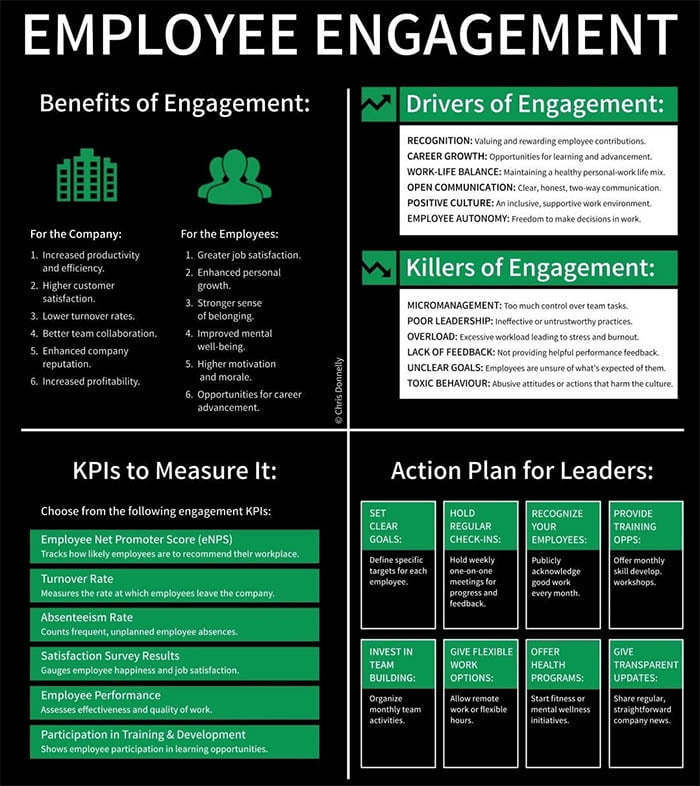
Credit & source: Justin Wright