

Credit & article source:
Christian Rebernik
Business complexity has intensified dramatically, with today’s organizational decisions requiring 65% more cognitive processing than those made just two years ago. This escalation stems from interconnected global markets, accelerated technological change, and increasingly dynamic stakeholder expectations. In response, high-performing leaders have developed systematic thinking frameworks that transform overwhelming complexity into manageable, repeatable decision protocols.
Mental models serve as cognitive architecture for executive decision-making. Rather than relying on intuition alone, these frameworks provide structured approaches that maintain effectiveness under pressure while reducing decision fatigue. Research in cognitive psychology and organizational behavior demonstrates that leaders who employ systematic thinking models consistently outperform peers in both decision quality and implementation speed.
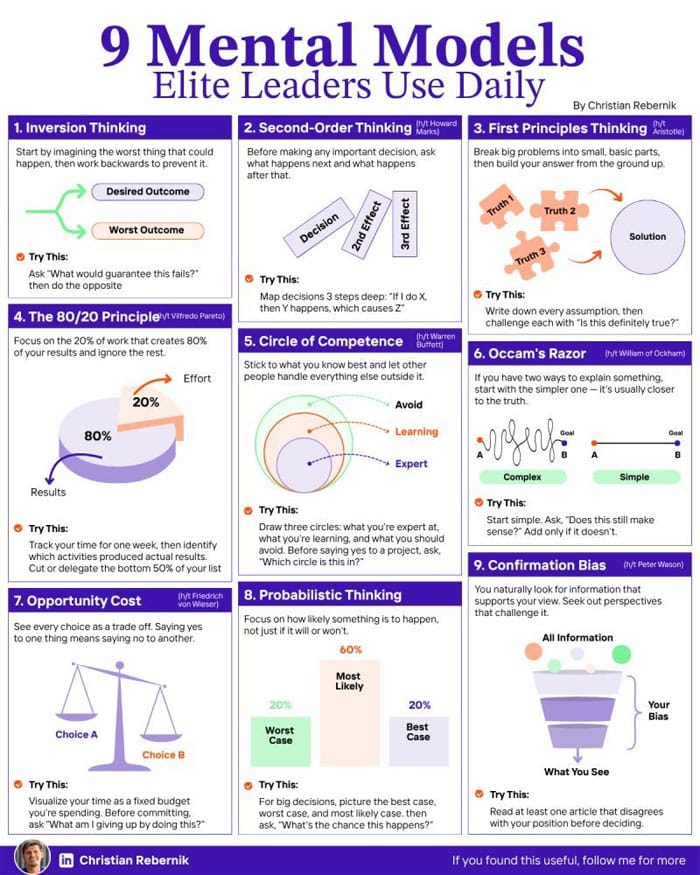
1. Inversion Thinking: Engineering Failure Prevention
Inversion thinking, attributed to mathematician Carl Jacobi’s principle “invert, always invert,” begins by conceptualizing the worst possible outcome and working backward to prevent it. This approach counters the human tendency toward optimism bias in strategic planning.
Charlie Munger applied this framework extensively at Berkshire Hathaway, systematically identifying failure modes before committing capital. The methodology proves particularly valuable in risk assessment and strategic planning contexts.
Implementation Framework: Before launching any significant initiative, conduct a premortem analysis. Document three specific failure scenarios with corresponding probability assessments. For each identified risk, develop concrete prevention protocols. This process transforms abstract concerns into actionable safeguards, substantially reducing blind spots in strategic execution.
2. Second-Order Thinking: Mapping Consequence Cascades
Second-order thinking, advanced by economist Thomas Sowell and strategist Ray Dalio, extends analysis beyond immediate outcomes to encompass ripple effects across systems. This framework addresses the limitation of first-level thinking, which stops at direct consequences.
Organizations frequently optimize for immediate metrics while inadvertently creating downstream problems. Cost reduction initiatives may improve quarterly results while degrading customer experience, ultimately eroding market position. Second-order thinking illuminates these hidden trade-offs.
Implementation Framework: Structure decision analysis in three-step sequences. If implementing Decision A produces Result B, systematically evaluate what Result B subsequently causes (Effect C). Document this chain for major decisions, particularly those affecting organizational culture, customer relationships, or operational capacity. This mapping reveals unintended consequences before they materialize.
3. First Principles Thinking: Deconstructing to Fundamentals
First principles thinking, utilized extensively by Elon Musk and rooted in Aristotelian logic, involves breaking complex problems into fundamental truths and reconstructing solutions from that foundation. This methodology challenges inherited assumptions that constrain innovative problem-solving.
When SpaceX analyzed rocket costs, first principles thinking revealed that raw materials represented only 2% of traditional pricing. By questioning industry assumptions about manufacturing and reusability, the company achieved cost reductions exceeding 90%.
Implementation Framework: When facing complex challenges, document every assumption underlying current approaches. Systematically interrogate each assumption with the question “Is this definitively true, or is it inherited practice?” Rebuild solutions using only verified fundamentals. This process often reveals that seemingly immutable constraints are actually malleable conventions.
4. The 80/20 Principle: Optimizing Resource Allocation
The Pareto Principle, formalized by management consultant Joseph Juran, observes that approximately 80% of outcomes derive from 20% of inputs. This distribution pattern appears consistently across business contexts from revenue concentration to productivity drivers.
Effective leaders apply this framework to identify high-leverage activities and eliminate low-return efforts. The principle serves as both diagnostic tool and allocation guide, enabling strategic focus on disproportionate value creators.
Implementation Framework: Conduct a comprehensive time audit across one operational week. Categorize activities by outcome production. Calculate which efforts generate actual results versus merely consume resources. Systematically reduce or delegate the bottom 50% of activities ranked by impact. This reallocation creates capacity for high-leverage work without extending working hours.
5. Circle of Competence: Operating Within Expertise Boundaries
Warren Buffett’s Circle of Competence framework establishes clear boundaries between areas of genuine expertise, developing knowledge, and acknowledged ignorance. This mental model prevents costly errors that occur when leaders operate beyond their competency limits without appropriate safeguards.
Professional discipline requires recognizing competence boundaries and either developing required expertise, consulting specialists, or declining opportunities outside established circles. This approach may appear limiting, but research shows it consistently produces superior outcomes compared to overconfident expansion.
Implementation Framework: Before accepting significant responsibilities or making strategic commitments, explicitly categorize the required knowledge as expert-level (inner circle), learning-stage (middle circle), or outside current competence (outer circle). For decisions touching outer circles, establish mandatory consultation protocols with recognized experts. This system maintains decision quality while supporting strategic learning.
6. Occam’s Razor: Preferencing Simplicity in Explanations
Occam’s Razor, formulated by philosopher William of Ockham, posits that when multiple explanations exist, the simplest sufficient explanation is most likely correct. In business applications, this principle combats the tendency toward unnecessary complexity in both problem diagnosis and solution design.
Organizations frequently develop convoluted processes and explanations when simpler alternatives would prove more effective. Complex solutions introduce additional failure points, training requirements, and maintenance costs without proportional benefit.
Implementation Framework: When presenting proposed solutions, challenge yourself to reduce complexity by 50%. If the streamlined version still addresses core requirements, adopt the simpler approach. Systematically question whether added complexity generates proportional value. This discipline produces more robust, maintainable systems.
7. Opportunity Cost: Recognizing Implicit Trade-offs
Opportunity cost, fundamental to economic thinking, acknowledges that selecting any option simultaneously forecloses alternatives. Every resource commitment represents an implicit decision against other potential applications.
Leaders often evaluate options in isolation rather than comparatively. This analytical gap obscures true decision costs, particularly regarding time and attention, the most constrained executive resources.
Implementation Framework: Before major commitments, explicitly document what you’re choosing not to do. Treat time as fixed capital with concrete budgeting requirements. Prior to accepting new responsibilities, identify which current activities will necessarily receive reduced attention. This framework transforms abstract trade-offs into explicit choices, improving allocation decisions.
8. Probabilistic Thinking: Quantifying Uncertainty
Probabilistic thinking replaces binary success/failure frameworks with likelihood distributions. Rather than asking “Will this work?” effective analysts ask “What is the probability distribution of potential outcomes?” This approach, central to professional forecasting and risk management, produces more sophisticated strategic decisions.
Professional poker players and successful investors think probabilistically by default, making optimal decisions based on expected value rather than guaranteed outcomes. This methodology maintains performance quality in inherently uncertain environments.
Implementation Framework: For significant decisions, estimate probability ranges rather than point predictions. Document best-case (20% probability), most-likely (60% probability), and worst-case (20% probability) scenarios. Calculate expected values across these distributions. This analysis reveals whether apparent opportunities actually represent positive expected value after accounting for uncertainty.
9. Confirmation Bias: Counteracting Selective Information Processing
Confirmation bias represents the cognitive tendency to seek, interpret, and recall information that confirms existing beliefs while discounting contradictory evidence. Research by psychologist Peter Wason demonstrates this bias operates unconsciously even among trained analysts.
High-stakes decisions require active measures to counter this pervasive tendency. Organizations that institutionalize contradiction-seeking processes demonstrate measurably improved decision quality.
Implementation Framework: Before finalizing significant decisions, mandate that at least one team member develop the strongest possible counter-argument. Read minimum one substantial article presenting opposing perspectives. Actively seek disconfirming evidence with the same rigor applied to supporting research. This disciplined approach substantially reduces blind spots in strategic analysis.
Building Compound Decision Advantage
Mental models function as cognitive infrastructure, each framework strengthening decision-making capacity. Leaders who systematically apply these thinking tools develop compound advantages over time, as improved decisions generate superior outcomes that create expanded opportunities.
The frameworks presented require neither exceptional intelligence nor extensive resources. Their power derives from systematic application rather than occasional use. Organizations can institutionalize these models through team training, decision protocols, and cultural reinforcement.
Professional development in mental models begins with deliberate selection. Rather than attempting simultaneous adoption, identify which framework addresses your most pressing decision challenges. Apply that single model consistently for thirty days, documenting applications and outcomes. This focused approach builds genuine capability rather than superficial familiarity.
As business complexity continues its documented acceleration, the competitive advantage increasingly belongs to leaders who think systematically rather than simply work harder. Mental models provide exactly this systematic advantage, transforming cognitive capability into organizational performance.